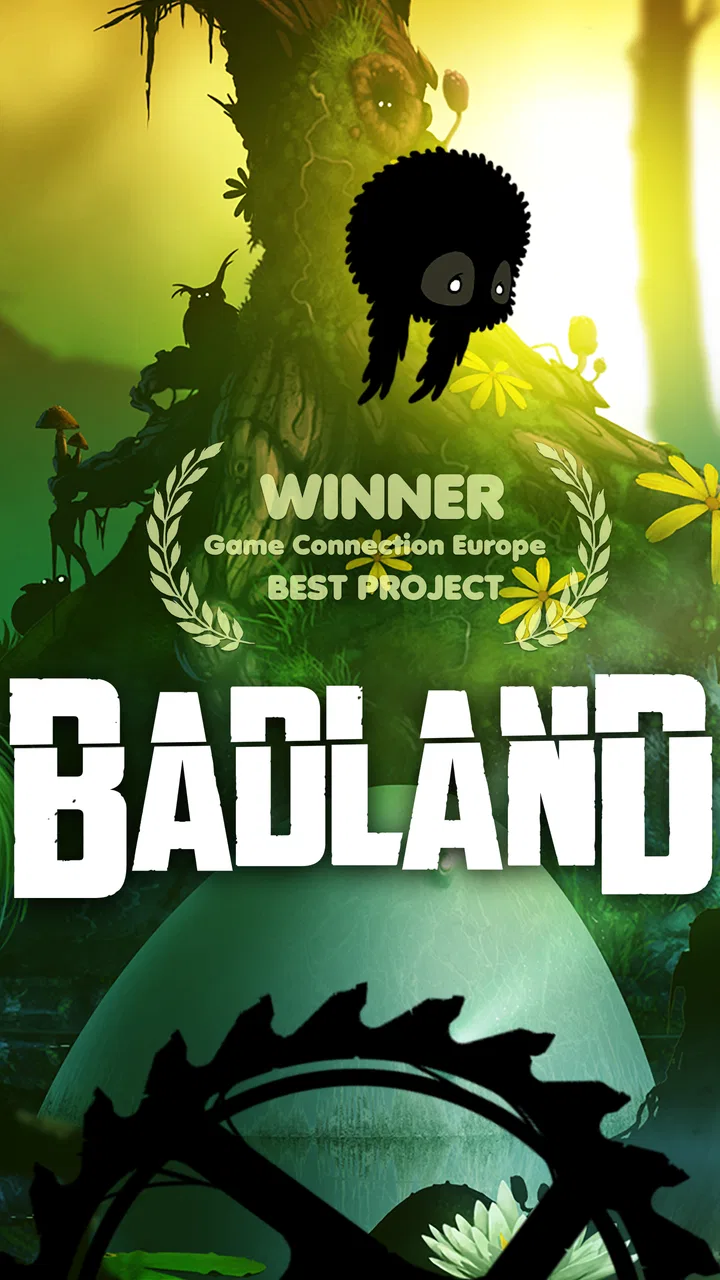
BADLAND
- 4.1
- Rating
- 50.00M
- Installs
- Free
- Price

 Analysis by App-foxy
Some mobile adventures ask you to follow a story, while others are built around a single action that becomes more demanding every few seconds. BADLAND belongs firmly to the second group. I guide a small flying creature through a dark forest, keeping it airborne while the environment turns into a chain of traps, moving objects, narrow passages, and sudden changes in pace. It is simple to understand, but it is not a casual game in the sense of being effortless.
I find it most appealing when I want a game that works in short bursts yet still rewards concentration. A quick attempt can fit into a spare moment, but the level design encourages me to replay sections and improve my timing. The atmosphere also gives it more personality than many endless-style mobile games. It feels mysterious, slightly strange, and visually distinctive without relying on a complicated menu system or a long explanation before play begins.
Developed by HypeHype Inc., this free adventure game has built a very large audience, with more than fifty million installs and an average rating of 4.2 from roughly one and a half million ratings. It is suitable for Everyone, runs on devices using Android 6.0 or later, and the current version is 3.2.1.5. Those details make it easy to approach, but the real question is whether its particular combination of physics, timing, and repetition suits the way you like to play.
You May Also Like

 AccuWeather: Weather Radar
AccuWeather Review: A Quick, Clear Forecast for Everyday Decisions
For everyday plans, the best forecast is the one you can understand quickly. AccuWeather makes rain timing, radar, and local conditions easy to act on, with a few trade-offs.

 Hill Climb Racing
Why Hill Climb Racing Still Turns Crashes Into One More Run
A tiny car, a bumpy hill and one more upgrade: Hill Climb Racing keeps resurfacing because its simple chaos makes every near-miss feel personal.

 AliExpress - Shopping App
AliExpress Makes Global Shopping Feel Personal, but Shoppers Bear the Risk
AliExpress turns a global marketplace into a pocket-sized discovery engine. Its reach is useful, its shopping loop compelling, and its trade-offs easy to miss.

 Lords Mobile: Kingdom Wars
Lords Mobile Is a Kingdom-Building Routine, Not a Quick Match
A case-by-case verdict on the building, battles, device demands, and social commitments that make Lords Mobile rewarding for some players and exhausting for others.

 PDF Scanner app - TapScanner
TapScanner Makes Paperwork Easier to Capture, Check, and Share
TapScanner makes scanning with a phone feel less like a rescue operation and more like a dependable step in getting work done. Its capture tools are useful, though not flawless.

 Block Blast!
 Shows How Much a Puzzle Game Can Leave Out
A quiet grid game shows why puzzle players increasingly value instant clarity, repeatable skill and low-pressure play—and where the genre still needs to catch up.
More From Our News Desk
View All News


How I Decide Whether BADLAND Is the Right Adventure Game
I use a few simple checks to decide whether BADLAND deserves a place on my phone: whether its one-touch flying still feels satisfying, whether retries teach me to read a route better, and whether the moody forest keeps me interested after the first surprise. Those checks matter more than a quick burst of novelty. Next, I look at how its focused challenge compares with other adventure games I might return to.
The first test is how you feel about control
The central control is wonderfully direct: I tap to make the character rise and release to let it fall. That sounds almost too basic, yet the game gets considerable depth from momentum. A tap is not merely an instruction to move upward; it changes the creature’s position and rhythm, and the next obstacle may require a very different touch pattern. I quickly learned that frantic tapping is usually worse than calm, deliberate input.
This makes BADLAND a poor choice if you want a game where a character follows a long list of commands or where success depends mostly on upgrading equipment. There is no comfort in becoming dramatically stronger and then passing a difficult section. My progress comes from learning the route, recognizing danger, and repeating a movement until it becomes reliable. If you enjoy that kind of improvement, the design feels fair and satisfying. If you prefer relaxed exploration, it can feel demanding.
Atmosphere matters more than a conventional story
The forest setting is one of the strongest reasons I remember this game. The silhouette-based presentation gives the world a moody look, and the contrast between the dark surroundings and the small moving character keeps hazards readable. I do not play it for dialogue or character development. I play it for the feeling of moving through an unfamiliar place where every mechanical detail might affect my route.
That distinction is important when comparing it with story-led adventure games. BADLAND communicates through scenery, motion, and obstacles rather than through conversations or a large narrative structure. Players looking for a rich plot, named companions, or a map full of optional quests should choose a different kind of adventure. Players who like environmental mood and compact action may find that the lack of exposition keeps the experience focused.
Short sessions are useful, but repetition is part of the bargain
I can open the game for a brief session and get straight into the action, which makes it convenient for commuting, waiting rooms, or a few minutes before bed. At the same time, a short session does not always mean a relaxed one. A difficult passage can demand several attempts, and the desire to finish it can turn a planned five-minute break into a much longer run.
My practical advice is to treat each failed attempt as information rather than as wasted time. Instead of immediately repeating the same frantic movement, I watch what caused the mistake: a late rise, an obstacle approached too quickly, or a narrow opening entered from the wrong angle. This small change in attitude makes the game considerably less frustrating and is one of the reasons it remains playable after the novelty wears off.
What I look for in the first few sessions
When deciding whether to keep a mobile game installed, I usually check three things: whether the controls remain dependable, whether failure teaches me something, and whether the presentation gives me a reason to return. BADLAND performs well on all three, with one qualification. The controls are easy to understand, but precision depends on the screen response and on my own timing. A device with a small display or distracting touch issues could make tight sections less comfortable.
I also pay attention to whether the game feels like it is asking for money before I have understood the basic experience. BADLAND is free to start and includes in-app purchases priced from $0.99 to $3.99 per item. That is worth knowing before downloading, especially for anyone who prefers games with no optional spending. For me, the sensible approach is to play the free experience first and decide later whether any purchase genuinely improves my use of it.
Where BADLAND has a clear advantage
Its biggest strength is the way a tiny control idea supports a surprisingly rich challenge. Many mobile games add buttons, abilities, currencies, and upgrade menus to create depth. Here, depth comes from the interaction between flight, speed, obstacles, and the shape of the environment. I spend less time managing a character and more time understanding movement. That makes every successful passage feel earned rather than purchased or assembled from statistics.
The visual style is another meaningful advantage. The dark forest is not just decoration placed behind a generic action game. It affects how I read the screen. Shapes emerge from the background, hazards blend into the scenery until I learn their patterns, and the moving silhouettes make the action easy to follow without covering the display with labels. I can recognize the game quickly even after leaving it for a while.
BADLAND also wins when I want a game that does not overload me with systems. I do not need to study a build, compare equipment, or remember a large collection of special moves. The challenge is concentrated in movement and observation. That makes it a strong recommendation for someone who likes arcade-style precision but wants more atmosphere than a plain score-chasing game usually provides.
A useful way to practice difficult sections
One of my more effective habits is to separate survival from speed. On an early attempt, I focus only on staying alive and learning the order of obstacles. I resist the temptation to rush through an open stretch just because it looks safe. Once I understand where the route tightens, I replay it with smoother taps. This two-stage approach works better than trying to perform perfectly from the first second.
I also try to keep my finger movements consistent. Large, irregular taps make the creature bounce through the level unpredictably, while smaller repeated inputs give me more control in narrow areas. There is no complicated technique to memorize, but the difference between a measured rhythm and panic is substantial. This is the kind of insight a short store description cannot communicate, and it is central to enjoying the game rather than simply enduring it.
Multiplayer-style moments change the feel of a run
When several creatures appear together, the experience becomes more chaotic and visually busy. I have to think about the group rather than only about one position on the screen. That can create exciting moments because the scene feels alive, but it can also make a mistake harder to diagnose. If I fail during a crowded sequence, I sometimes replay it simply to understand which movement caused the problem and which part was caused by the group’s changing shape.
This is a good example of a trade-off that matters when choosing between categories. A minimalist solo reflex game may offer cleaner feedback, while BADLAND’s crowded moments provide more spectacle and surprise. Neither approach is automatically better. I prefer BADLAND when I want the environment and the moving group to create tension together, but I would choose a more stripped-down alternative when I am trying to practice pure reaction speed.
Where another type of game may fit better
Players who want a peaceful adventure should think carefully before installing it. The forest looks calm at first glance, but the actual play is built around danger and recovery. A puzzle game with unlimited time may be a better fit for someone who wants to plan without pressure. A traditional platform game may suit someone who expects clear jumping arcs, separate action buttons, and familiar character movement. BADLAND is more unusual because the entire body of the creature responds to one repeated input.
It may also be the wrong choice for someone who needs a strong long-term progression system. I do not return because I am collecting a large inventory or building a character in the usual role-playing sense. I return because I want to handle the route better than before. That is a rewarding loop, but it depends on personal motivation. If your ideal mobile game gives you new gear, extensive customization, or a constantly expanding map, another adventure category will probably hold your attention longer.
There is a similar distinction between BADLAND and endless runners. Both can be understood quickly and both reward timing, but the experience is not identical. In an endless runner, the attraction often comes from chasing a longer distance or a higher score as the course keeps changing. Here, I feel more connected to learning authored spaces and handling specific situations. Someone who enjoys repeating a known challenge may prefer this structure; someone who wants an infinite stream of surprises may prefer an endless format.
Choosing between free access and optional purchases
The free entry point lowers the risk of trying the game. I can find out whether the one-touch flying mechanic suits me before spending anything. That is especially useful because the game’s appeal is highly personal: some players will immediately enjoy the rhythm, while others will find the repeated attempts tiring. The purchase range is modest in absolute terms, but I still recommend deciding in advance whether you want to keep spending disabled.
My own rule is simple: I would not buy anything to solve a section that I have not first tried to understand. The main satisfaction comes from improving my control, so spending should never replace practice. If an optional item makes the game more convenient for your habits, that is a personal choice, but the core decision should be based on whether the movement and atmosphere already work for you without extra help.
The real cost of switching from another mobile adventure
Switching to BADLAND does not require learning a large control scheme, but it does require changing expectations. Someone coming from a button-based platformer may initially press or swipe where only tapping is needed. Someone coming from a relaxed puzzle game may need time to accept that a failed attempt is part of the learning loop. The low number of controls does not mean there is no adjustment; it means the adjustment is mostly about timing and patience.
If you are replacing an endless runner, the biggest change is psychological. You may stop thinking only about distance and start memorizing the behavior of a particular section. I find that this creates a stronger sense of mastery, but it can also make repeated failure feel more personal. The game is not asking whether I have a powerful enough character. It is asking whether I can make the next movement correctly.
There is almost no menu-related learning curve, which is a genuine convenience. I can concentrate on the screen instead of managing a complicated progression path. The trade-off is that players who enjoy planning outside the action may feel there is less to do between attempts. Before switching, I would ask myself whether I want a focused skill game or a broader adventure package with exploration, customization, and more conventional progression.
Everyday use: a short break that can become a challenge session
Imagine having ten minutes before an appointment. BADLAND is easy to start, and the control explanation is not likely to delay you. I might play a few attempts, identify one troublesome obstacle, and stop with a clear idea of what to try next time. That makes it more satisfying than a game where a short session ends before anything meaningful happens.
There is a warning, though. Because the game encourages “one more attempt,” it is not ideal when I need a guaranteed stopping point. If I am waiting for a call or trying to fall asleep, a difficult section can keep my attention longer than planned. I use it for active breaks rather than for relaxation. That small distinction has helped me enjoy it without allowing the challenge to take over the rest of my evening.
Device expectations and day-to-day comfort
The minimum operating-system requirement is Android 6.0, so the game is accessible to a wide range of older Android devices that still meet that requirement. On any phone, comfort will depend on the screen, touch response, and how easy it is to keep a finger positioned without blocking important visual information. I prefer holding the phone securely with one hand and using a light touch, rather than gripping tightly during difficult sequences.
Because the action is visual and timing-sensitive, interruptions are more disruptive than they would be in a turn-based game. A notification, an accidental touch, or a moment of divided attention can ruin a run. I would not judge the game harshly for that; it is a natural consequence of its design. Still, people who frequently play while multitasking should know that BADLAND rewards full attention more than background play.
Who I would recommend it to
I recommend BADLAND to players who enjoy atmospheric mobile adventures, compact controls, and challenges that improve through repetition. It is especially suitable for someone who wants a game that feels distinctive without requiring a long tutorial. The combination of a shadowy setting and responsive flying movement gives it an identity that many quick-play titles lack.
I would also suggest it to people who like sharing a device or showing a game to a friend, because the action is understandable almost immediately. A friend can see what I am trying to do without needing a long explanation of character classes or equipment. That does not make it universally easy, but it does make the basic idea approachable.
I would skip it if I dislike restarting, if I need a calm pace, or if I judge value mainly by the amount of customization and story content. I would also be cautious if optional purchases make a free game uncomfortable for me, even though I can begin without paying. In those cases, a slower puzzle adventure or a story-focused game would probably provide a better match.
My final recommendation
After weighing the alternatives, I see BADLAND as a focused adventure rather than an all-purpose mobile game. It succeeds because it takes one movement idea seriously and builds an atmospheric challenge around it. The result is easy to start, difficult to master, and distinctive enough to remain memorable. The same focus creates its limitations: repetition, pressure, and a smaller emphasis on story or conventional progression.
The game first appeared on November 28, 2013, yet its basic design still feels well suited to modern short-session play. Its age is less important to me than the clarity of the experience. I can understand the objective quickly, but I still have room to improve after many attempts. That is a valuable combination for a free game, provided I enjoy learning through failure.
My clear recommendation is to try it if you want a visually moody, timing-based adventure and are comfortable with retrying difficult passages. Start with a few sessions without making a purchase, use the early attempts to learn movement rather than chase speed, and notice whether the atmosphere keeps drawing you back. BADLAND is at its best when you want a compact game that tests your hands and attention, not when you want a relaxed story or a deep upgrade system.
For me, that makes it an easy recommendation to a friend who likes precise mobile play but wants something more memorable than a standard runner. I would describe it as a game to approach with patience: the controls are simple, the world is inviting, and the challenge becomes rewarding once I stop fighting the rhythm and start reading the environment.
FAQs for BADLAND
01What is the main objective of BADLAND?
BADLAND is an atmospheric side-scrolling action-adventure game where the main objective is to navigate your character through a beautifully crafted forest filled with traps, obstacles, and puzzles. Players must strategically maneuver the character to survive and progress through various levels, each with unique challenges and environments.
02Is BADLAND available for both Android and iOS devices?
Yes, BADLAND is available for both Android and iOS platforms. Players can download the game from the Google Play Store or the Apple App Store, ensuring compatibility with most smartphones and tablets. The game offers a seamless experience on both operating systems, maintaining its stunning visuals and engaging gameplay.
03Does BADLAND support multiplayer gaming?
BADLAND offers a local multiplayer mode where up to four players can compete on the same device. This mode allows friends and family to play together, adding a competitive edge to the game. Players can also engage in co-op campaigns, working together to overcome challenges and enjoy the immersive environment.
04Are there in-app purchases in BADLAND?
While BADLAND is free to download, it does include in-app purchases. These purchases can enhance the gaming experience by unlocking additional content, such as new levels or characters. Players have the option to enjoy the core game without spending money, but those looking for more content can explore these paid options.
05How is the gameplay experience in BADLAND?
The gameplay in BADLAND is highly immersive and visually captivating, featuring intuitive touch controls that are easy to learn but challenging to master. The game is renowned for its atmospheric sound design and stunning, hand-painted graphics, which together create a rich and engaging experience that keeps players coming back for more.
Pros
- Stunning visual design and immersive atmosphere.
- Simple
- intuitive controls enhance gameplay.
- Unique and engaging level designs.
- Supports multiplayer for up to four players.
- Regular updates with new levels and features.
Cons
- Occasional lag on older devices.
- In-app purchases can be pricey.
- Some levels can feel repetitive.
- Limited replay value after completion.
- No offline multiplayer mode.

BADLAND
Gallery